

CRAFTING PHILOSOPHY

PICKING
Clear days only. After nine, before four. One shoot, two to three leaves (一芽二至三叶). The thumb and index finger straddle the stem and snap upward. In Fenghuang, they call this the horseback style (骑马式). Clean separation, no bruising.
The oldest trees are picked one by one. One tree, one basket. Dancong (lit. single bush) at its most literal.

SUN-WITHERING
The leaves are spread out in the late afternoon sun. Moisture drops. The grassy rawness fades. The first fragrance lifts.
An hour, sometimes two. Turned twice by hand. Different plots kept separate, withered in the order they were picked.

COOLING
Indoors. Bamboo racks. One to two hours of stillness.
The moisture inside the leaf redistributes, the surface and the centre find balance. The local term: fan huo (返活). Coming back to life.

THE NIGHT’S WORK
Most of the character of a Dancong emerges in a single night.
From early evening until dawn, the leaves are tossed, rested, tossed again. First by hand (手碰), then in bamboo trays (摇筛), then a tumbler (摇笼). Five to seven rounds. Two minutes of movement, hours of stillness.
The principle: xun xu jian jin (循序渐进). Incremental changes. Nothing forced.
Each toss bruises the leaf edge just enough to start oxidation. Through the night the fragrance shifts: grassy, then floral, then sweet. The tea maker does not follow a timer. He watches the colour, smells the air, and decides.
When it is done, the edges carry a fine red line against a green centre. 绿叶红镶边. The classic mark. Stop too early: thin. Too late: flat.

KILL-GREEN
The moment is chosen carefully, through skill and experience, to immortalise the leaf’s essence. At dawn, the leaves meet hot iron. 180 degrees. The family calls it sha qing (杀青), meaning ’frying the tea.‘ The enzymes halt. The night’s aroma locks in place. Heat is applied to preserve the leaf as it is at the moment of harvest, performed to protect what already exists.
Five to six minutes, the result is read five ways: sight, pinch, fold, smell, moisture. Flavours shift toward roasted chestnuts and warm flowers. Then the leaves are spread immediately to cool (散热). Trapped heat undoes a night’s work in minutes. Once the heat has done its work, the urgency fades. Time stretches again.

ROLLING
Rolled warm, the leaves take their twisted shape.
The pressure follows a rhythm: light, heavy, loose, heavy, loose (轻–重–松–重–松). Eight to ten minutes. Twist without breaking. The surface bruised just right, juices released here is what you will later taste.

THE THREE FIRES
The final character is written in fire.
First fire (毛火): fast, hot, 100–110°C. Drives off surface moisture.
Second fire (二焙): gentler, 90°C, twenty to thirty minutes. The aroma smooths.
Third fire (足火): the most delicate, around 80°C. Any higher and the fragrance evaporates. Done when the stem snaps, the leaf crumbles, and the moisture sits at five per cent.
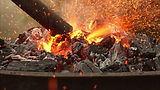
The Liu family roasts over lychee wood charcoal. The heat is uneven, alive. It shifts with every current of air. The tea maker stands by for hours. The margin between a clean roast and a ruined batch is a matter of degrees.

SORTING
Before the tea leaves the mountain, it is sorted. Every leaf passes under the eye and through the fingers. Only whole, intact shoots are kept. Broken edges, loose stems, anything uneven is pulled out by hand.
The work is fast and exacting. Sharp eyes, quick fingers.
What remains is clean.
RE-ROASTING
A good Dancong rarely finishes with three fires alone. After sorting, the tea is roasted again. This may happen more than once, each round deepening the flavour and drawing off residual moisture.
Between fires, the tea rests for days, sometimes weeks. The aroma stabilises. The flavours fold inward. Fire without rest is just burning.

THE TASTING TABLE
Before any tea leaves the mountain, the father tastes it.
A handful of leaf, a gaiwan, boiling water. Brewed, poured, brewed again. He reads how it opens, where the sweetness sits, whether the mountain character (shan yun, 山韵) comes through.
A tea that does not pass this table does not carry the name.
From fresh leaf to finished tea, every step engages all five senses, continuously assessed through experience: the moment the stem snaps clean between the fingers, the colour at the edge of a leaf, a fragrance shifting in a quiet room. Temperature, time, humidity. Each one a dial that shapes what ends up in your cup.
The process is long and precise. It looks, at times, raw. Leaves spread on bamboo in the sun. An artisan turning them by hand at three in the morning. Charcoal glowing in an iron kiln. But inside this roughness lives an exactness that tolerates no error. One degree too high, ten minutes too long, and the flavour collapses.
This way of making tea has outlived dynasties. It asks the same things it always has: patience, precision, and someone willing to stay up all night. Yanwu is its keeper.
PICKING
Clear days only. After nine, before four.
One shoot, two to three leaves (一芽二至三叶).
The thumb and index finger straddle the stem and snap upward.
In Fenghuang, they call this the horseback style (骑马式). Clean separation, no bruising.
The oldest trees are picked one by one.
One tree, one basket. Dancong (lit. single bush) at its most literal.

What arrives in your cup has been listened to at every stage.
The mountain grew it slowly. The family shaped it carefully.
And between the two, someone stayed up all night,
because the leaf asked them to.